Your filter is the hardest-working piece of equipment on your pool. It pulls dirt, oils, and fine particles out of the water every time the pump runs, and how well it does that depends on which of the three main filter types you own.
Sand, cartridge, and Diatomaceous Earth (D.E.) filters each strike a different balance between filtration fineness and how much hands-on maintenance they demand. This guide breaks down how each one works, the upkeep schedule it needs, and the replacement parts that keep it running.
How the Three Filter Types Compare
The quick version: sand is the simplest and cheapest but filters the coarsest; D.E. gives the clearest water but asks the most of you; cartridge sits in the middle and saves water because it never needs backwashing. Here's the side-by-side.
| Filter Type | Filters Down To | Routine Cleaning | Media Lifespan |
|---|
| Sand | 20–40 microns | Backwash every 1–2 weeks | Replace sand every 3–5 years |
| Cartridge | 10–15 microns | Rinse every 2–4 months | Replace element every 1–3 years |
| D.E. | 1–5 microns | Backwash every 1–3 months | Replace grids every 3–5 years |
Across all three, one rule holds: clean the filter whenever the pressure gauge climbs 8 to 10 PSI above its clean baseline. Rising pressure means restricted flow, which strains your pump and lets water go cloudy.
Sand Filters
Sand filters are the most common and the most forgiving. Water is pushed through a bed of specialized sand that traps debris down to about 20 to 40 microns. They need the most frequent routine cleaning, but the media itself lasts for years.
- Backwashing: reverse the water flow every 1 to 2 weeks, or when pressure rises 8 to 10 PSI over the clean baseline.
- Deep cleaning: once a year, run a chemical sand cleaner through the bed to strip out oils and mineral buildup that backwashing leaves behind.
- Media replacement: the sand grains wear smooth over time and filter less effectively, so replace the sand every 3 to 5 years.
- Alternative media: zeolite or recycled glass media can replace standard silica sand for noticeably finer filtration.
Cartridge Filters
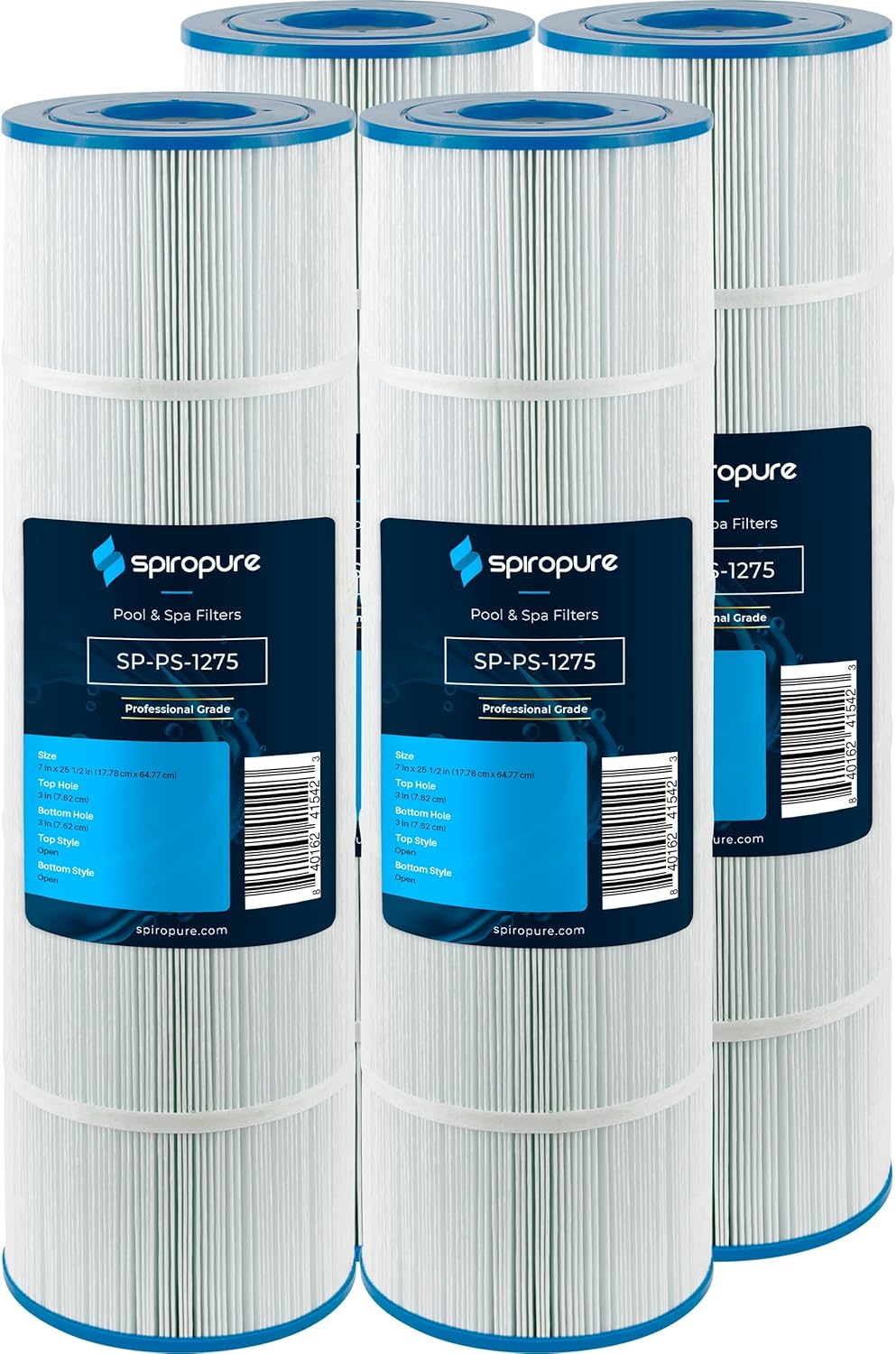
Cartridge filters trap finer debris than sand (roughly 10 to 15 microns) and never need backwashing, so they waste no water. Instead you periodically pull the pleated element out and rinse it off.
- Rinsing: hose down the cartridge every 2 to 4 months with a garden hose and spray nozzle, working between the pleats.
- Chemical soaking: once a year, soak the element in a cartridge cleaning solution to dissolve embedded oils and sunscreen that rinsing can't reach.
- Element replacement: fabric elements fray and lose flow over time. Replace them every 1 to 3 years.
- Watch the gauge: clean immediately if tank pressure climbs 8 to 10 PSI above normal.
Diatomaceous Earth (D.E.) Filters
D.E. filters deliver the clearest water of the three, trapping particles down to 1 to 5 microns by coating internal grids with a fine powder. The tradeoff is the most involved maintenance, including recharging the powder after every backwash.
- Backwashing: reverse the flow every 1 to 3 months, or when the pressure gauge signals a restriction.
- Powder recharging: after every backwash you must add fresh D.E. powder through the skimmer to re-coat the grids.
- Manual teardown: at least once a year, open the filter and hose down the internal grids completely.
- Grid replacement: the fabric grids (and the manifold) generally last 3 to 5 years before they tear and need replacing.
Not sure how much water your pool holds, which determines how much D.E. powder to add? Use our volume calculator first.
Sand vs. Cartridge vs. D.E.: Which Should You Choose?
If you're deciding between the three, the right pick comes down to what you value most: the lowest upfront cost and least fuss, the clearest possible water, or a balance of the two. Here's the honest head-to-head.
Choose a SAND filter if: you want the cheapest system to buy, the simplest to operate, and you don't mind backwashing every week or two. It's the most forgiving choice for a first-time pool owner, and coarse filtration is fine for most backyard pools kept on a normal chemical routine.
Choose a CARTRIDGE filter if: you want finer water clarity than sand without much hands-on work, and you care about saving water (no backwashing). This is the best all-round choice for most homeowners, and it's especially worth it where water is expensive or restricted.
Choose a D.E. filter if: crystal-clear, polished water is your top priority, you have very fine debris or algae issues, and you're willing to recharge powder after each backwash. It filters the finest by far, at the cost of the most maintenance.
The most common upgrade path is sand to cartridge: owners get tired of wasting water on backwashing and want clearer water without the D.E. workload.
The Real Cost of Each Filter Type
Sticker price is only part of the story. The ongoing cost of media, water, and your time adds up differently for each type over its life.
| Filter Type | Typical Upfront Cost | Ongoing Media Cost | Water Used |
|---|
| Sand | $300–$700 | Sand refill every 3–5 yrs (low) | High (backwashing) |
| Cartridge | $400–$900 | New element every 1–3 yrs (medium) | None |
| D.E. | $500–$1,200 | Powder after each backwash (ongoing) | High (backwashing) |
Prices vary by pool size and brand, but the pattern holds: sand is cheapest to buy and run, cartridge saves the most water, and D.E. costs the most over time because you keep buying powder. If your pump's electricity cost matters too, remember a clean filter of any type lets the pump move water with less resistance.
How to Size a Filter to Your Pool
An undersized filter clogs fast, clouds the water, and strains the pump; an oversized one is money wasted. Two numbers matter: your pool's volume and your pump's flow rate.
- Find your pool volume in gallons (use the calculator above).
- Aim to turn over (filter) the entire volume in about 8 hours. Divide gallons by 480 to get the minimum flow rate in gallons per minute (GPM).
- Pick a filter rated for at least that GPM, and match it to your pump so the filter's flow rating is equal to or greater than the pump's.
- When in doubt, size up slightly: a filter with more surface area needs cleaning less often and lasts longer.
Common Filter Mistakes to Avoid
- Cleaning on a fixed schedule instead of watching the pressure gauge, either cleaning too soon or letting flow choke.
- Backwashing a sand or D.E. filter too often, which actually reduces filtration (a slightly dirty bed filters finer than a spotless one).
- Forgetting to recharge D.E. powder after a backwash, which lets unfiltered water run and can damage the grids.
- Pressure-washing a cartridge element, which tears the pleats. Use a regular hose and nozzle instead.
- Never doing an annual chemical soak/clean, so oils and sunscreen build up and permanently reduce flow.
- Running a filter that's too small for the pump, which spikes pressure and shortens the life of both.
Frequently Asked Questions
Which pool filter type is best?
It depends on your priority. Sand is easiest and cheapest but filters the coarsest. Cartridge saves water and filters finer with moderate upkeep. D.E. gives the clearest water but needs the most maintenance. For most homeowners, a cartridge filter is the best all-round balance.
How do I know when to clean my filter?
Watch the pressure gauge. When it reads 8 to 10 PSI above the clean baseline, flow is restricted and it's time to backwash (sand/D.E.) or rinse (cartridge), regardless of the calendar schedule.
Can I switch from a sand filter to cartridge or D.E.?
Yes, but it means replacing the filter tank and sometimes adjusting plumbing. Many owners upgrade from sand to cartridge for finer filtration and to stop wasting water on backwashing. Match the new filter's flow rate to your pump.
D.E. vs. cartridge filter: which is better?
A D.E. filter traps finer particles (1-5 microns vs. 10-15 for cartridge), so it delivers slightly clearer water. But a cartridge filter needs far less work: no backwashing and no powder to recharge, just an occasional rinse. For most home pools the difference in clarity is small, so cartridge wins on convenience; choose D.E. only if you specifically need the finest possible filtration.
Is a sand or cartridge filter better for an above-ground pool?
Both work well. Sand filters are cheap and simple but need regular backwashing and a nearby drain. Cartridge filters cost a little more and skip backwashing entirely, which is handy for above-ground setups without easy drainage. If saving water and skipping backwash hassle matters, go cartridge.
How long do pool filters last?
The tank and housing typically last 8-12 years or more. The media is what you replace: sand every 3-5 years, cartridge elements every 1-3 years, and D.E. grids every 3-5 years. Regular cleaning and not overworking an undersized filter extend all of these.
Does a dirty filter make the pool cloudy?
Yes. As a filter clogs, flow drops and it can no longer clear fine particles, so the water turns hazy. Cloudy water combined with a high pressure-gauge reading is a classic sign it's time to clean or backwash the filter.